7 Best Commercial Meat Grinders for Home Use (November 2026)
The best commercial meat grinders for home kitchens include the LEM BigBite #8 Meat Grinder for quiet everyday grinding, the STX Turboforce II 4000 Grinder for soft bones and big batches, and the ARINOO Commercial Meat Grinder #12C for game and home butchering.
On this page (5 sections)
The best commercial meat grinder for home use is the LEM BigBite #8, because its stainless steel build, quiet running design and five-year warranty suit regular home batches better than anything else here. Go with the STX Turboforce II 4000 if you want soft-bone grinding or a foot pedal for sausage days.
A commercial-style grinder earns its place at home when you buy meat in bulk, hunt, or make sausage often. Size #12 and #8 heads and motors from 0.5 HP up in this group turn out ground meat far faster than a basic kitchen model, and the metal parts hold up to repeated runs.
The trade-off is weight and counter space. These machines run 12 to 47 lb, so measure your counter and storage spot before you choose.
If you only grind a pound or two a week, our guide to the best electric meat grinders for home use covers lighter options.
Our picks at a glance
-
1

-
2
 Best for soft bones and big batches
STX Turboforce II 4000 Grinder
8.7/10 our score
See it on Amazon -
3
 Best for game and home butchering
ARINOO Commercial Meat Grinder #12C
8.5/10 our score
See it on Amazon
- 4
 Check it
STX Turboforce 3000 6-in-1 Grinder
Best for sausage making - 5
 Best for high-volume daily prepCheck it
- 6
 Check it
Barton Commercial #12 Meat Grinder
Best for mixed meat and vegetable prep - 7
 Check it
FOHERE 1100W Commercial Meat Grinder
Best for small restaurant kitchens
The best commercial meat grinders for home kitchens
The LEM is the strongest all-round pick for most homes, while each of the others wins on a specific job: soft bones, game processing, sausage stuffing, volume or budget. Pick by the meat you grind most.
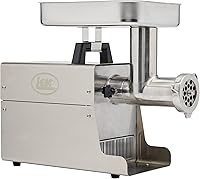
LEM BigBite #8 Meat Grinder: Best for quiet everyday grinding
- 0.5 HP motor
- About 7 lbs per minute
- Noise-dampening design
- Five-year factory warranty
A stainless steel grinder built for regular home batches, with sausage tubes and three plates in the box. The five-year warranty backs the long haul.
Pros
- Stainless steel build
- Quiet running design
- Sausage tubes and three plates included
- Five-year factory warranty
Cons
- #8 head suits smaller batches
- Will not grind bones
The LEM suits a home cook who grinds weekly and wants one machine that stays put for years. Its 0.5 HP motor pushes about 7 lbs of meat a minute, which is steady rather than frantic, and the noise-dampening design keeps the kitchen calmer than the bigger-wattage machines here.
Stainless steel parts and a permanently lubricated motor mean fewer maintenance chores. The box includes three plates, a knife, a stomper and stuffing tubes, so you can move from burgers to sausage without buying extras.
The three plates also let you switch between coarse and fine grinds in one session.
At 32.6 lb it's mid-weight for this group. The 20.24 by 9.13 by 15.98 inch footprint is compact enough for a counter corner, though the stainless body means it's better lifted with two hands.
It won't grind bones, so keep chicken frames and rabbit carcasses for a dedicated bone grinder. LEM backs it with a five-year factory warranty and lifetime customer support, plus replacement parts for past and present models.
For a home kitchen that wants commercial build quality without commercial noise, this is the pick. If you're shopping to a tighter budget, see our roundup of meat grinders under 200.
STX Turboforce II 4000 Grinder: Best for soft bones and big batches
- 2000 W locked motor
- Size #12 grinding head
- Handles soft bones
- Foot pedal included
The air-cooled motor and #12 head handle chicken and rabbit bones, and the foot pedal frees your hands while stuffing sausage.
Pros
- Grinds soft bones
- High-capacity feed tray
- Foot pedal for hands-free work
- Three-year warranty
Cons
- Largest set of accessories in the group
- Big footprint for a small kitchen
The STX Turboforce II 4000 is the only machine here that handles soft bones, so it's the pick for anyone grinding whole chickens or small game. Its size #12 head and 2-inch feed tube take larger cuts than a #8 grinder, and STX rates it for 220 to 260 lbs an hour depending on the plate and meat.
The locked motor runs at 2000 W with an air-cooled induction system and a circuit breaker. A foot pedal lets you start and stop hands-free, which matters when you're feeding meat into the hopper and holding a stuffer bag at the same time.
The 3 lb feed tray means fewer refills between pushes.
The kit is generous: six plates, three blades, three stuffing tubes, a kubbe maker, meat claws and a burger press. The trade-off is bulk, since the high-capacity tray and accessories need storage space.
At 13 lb the unit itself is light, but the polished aluminum head and extra plates still take a cabinet shelf.
Skip it if you never grind bones and want a simpler, quieter machine. Choose it if soft bones and big batches are the point.
Our explainer on what makes a good meat grinder for home use digs into head size and motor choice.
ARINOO Commercial Meat Grinder #12C: Best for game and home butchering
- 0.9 HP copper motor
- 1100 W peak power
- Two stainless plates
- Five-year factory warranty
A stainless steel workhorse with a reverse function to clear jams. It's aimed at hunters and small-farm processing rather than light weekly use.
Pros
- Stainless steel body
- Forward and reverse motor
- Two stainless plates and two knives
- Five-year factory warranty
Cons
- Heavy at 43 lb
- Not built for grinding bones
ARINOO's #12C suits hunters and small-farm processors who put venison and bulk beef through the machine. The 0.9 HP copper motor runs at 650 W rated and 1100 W peak, and ARINOO says it grinds up to 175 lbs in two hours.
A forward and reverse function helps clear a jam without disassembling the head. The stainless steel body and two stainless plates add durability for repeated game processing.
It also includes two knives and three plastic stuffing tubes, so coarse and fine sausage work is covered from day one.
The weight is the real trade-off: 43 lb makes it a machine you leave in one spot rather than move between counters. It also won't grind bones, so keep soft-bone work for the STX.
Note too that the plates are just 6mm and 8mm, so you get two grind sizes rather than the wider spread on the STX machines.
The five-year factory warranty matches the LEM's coverage. Pick it if game season fills your freezer and you want a dedicated meat grinder that can keep pace.
See how it fits alongside slicing gear in our home meat slicer, grinder and stuffer guide.
STX Turboforce 3000 6-in-1 Grinder: Best for sausage making
- 3000 W locked motor
- Three-speed control
- Foot pedal and kubbe kit
- Five grinding plates
A lighter #12 grinder with three speeds, stuffing tubes and a foot pedal. The kit covers sausage, kubbe and burgers in one box.
Pros
- Three-speed motor
- Foot pedal included
- Sausage tubes and kubbe attachment
- Three-year warranty
Cons
- Will not grind bones
- Lighter build than the commercial machines here
The Turboforce 3000 is the sausage maker's pick, thanks to its three-speed control and included foot pedal. Slower speeds give you more control when stuffing casings, and the pedal frees both hands for the job.
STX rates the locked motor at 3000 W but notes it usually draws 800 to 1200 W under load. The #12 head, five plates and three stuffing tubes cover coarse and fine grinds, plus a kubbe attachment for filled specialties.
A 2-1/8 inch hopper opening takes larger pieces of meat than a narrow #8 tube.
At 12.5 lb it's the lightest machine in this roundup, which makes it easier to lift onto a counter or store in a cabinet. That lighter build also means it's less suited to nonstop commercial volume than the ARINOO or VEVOR.
It won't grind bones. STX also warns against putting tendons, vegetables, nuts or fruit through it, so it's a meat-only machine.
Choose it for weekend sausage sessions and home burger prep rather than daily bulk processing. For the wider grinder landscape, our electric meat grinder guide compares lighter models too.
VEVOR #12 1 HP Meat Grinder: Best for high-volume daily prep
- 750 W / 1 HP copper motor
- 552 lbs per hour
- ETL listed
- Dishwasher-safe parts
A fast, ETL-listed mincer with removable parts that go in the dishwasher. It suits kitchens putting meat through the machine most days.
Pros
- High output rate
- ETL approved
- Dishwasher-safe removable parts
- Anti-vibration foot pads
Cons
- Not suitable for bones or frozen meat
- Motor housing needs hand wiping
The VEVOR is the volume pick for kitchens that grind most days. Its 750 W / 1 HP pure copper motor and 3-stage auger process up to 552 lbs an hour, and the ETL listing adds a safety credential the budget machines lack.
Cleanup is the standout feature: blades, plates, tubes, grinding head, auger and meat pan are dishwasher-safe. You only wipe the motor housing.
A rapid cold-air cooling system guards against overheating during long runs.
Anti-vibration foot pads and a locking knob keep the head steady. It handles chicken, pork, beef, fish and vegetables, but VEVOR says not to use it for bones or frozen meat.
The included kit covers two cross blades, 6mm and 8mm plates, three stuffing tubes and a kibbe kit.
At 36.6 lb it's mid-weight, and the aluminum body keeps it lighter than the stainless Barton. Pick it if output and easy cleanup matter most.
If you're also outfitting a slicing station, our meat slicer for home use guide covers the pairing.
Barton Commercial #12 Meat Grinder: Best for mixed meat and vegetable prep
- 1100 W motor
- #12 grinding head
- Stainless steel cutting blade
- Sausage tubes included
A heavy stainless grinder that handles beef, pork, chicken and vegetables. The weight keeps it planted during long grinding sessions.
Pros
- Stainless steel food-contact parts
- Handles a wide range of meats and vegetables
- Two plates and two cross blades
- Quiet offset head design
Cons
- Heaviest machine here at 47 lb
- Shorter 60-day manufacturer warranty
The Barton suits cooks who grind meat and vegetables in the same session. Its 1100 W motor and #12 head handle beef, pork, chicken and venison, and the stainless steel cutting blade and food-contact parts resist corrosion.
The offset head design runs quietly, which helps in an open kitchen. Two plates (6mm and 8mm), two cross blades and three sausage tubes ship in the box, so coarse and fine grinds are covered from day one.
The T-304 stainless construction is built to take commercial-style use.
The trade-off is weight: 47 lb is the heaviest machine here, so plan a permanent spot for it. Barton's manufacturer warranty runs 60 days, which is far shorter than the five-year coverage on the LEM and ARINOO.
The cleaning routine is simple, since the removable parts come apart and wash in warm soapy water.
Pick it if you want stainless parts and quiet operation for mixed prep. Skip it if warranty length is a priority or you need to move the grinder often.
Our guide to what makes a good meat grinder explains why motor and head size matter more than wattage claims.
FOHERE 1100W Commercial Meat Grinder: Best for small restaurant kitchens
- 1100 W copper motor
- 330 lbs per hour
- ETL approved
- Two blades and two plates
A budget-friendly commercial grinder for light commercial kitchens and serious home cooks. The aluminum body keeps the weight down compared with the stainless machines.
Pros
- ETL approved
- Handles meat and vegetables
- Two cutting blades and two plates
- Lower weight than the Barton
Cons
- Aluminum body rather than full stainless
The FOHERE is the budget entry into commercial-style grinding. Its 1100 W copper motor processes up to 330 lbs an hour, and the ETL listing gives it a safety credential at a lower price tier than the stainless machines.
Blade speed runs at 225 rpm for steady, continuous use.
It handles pork, beef, venison, chicken, garlic, chili and vegetables, so it doubles as a mincer for sauces and fillings. Two cutting blades, two plates and a sausage tube come included.
The aluminum body keeps the weight at 40.3 lb.
The trade-off is the aluminum body and stainless hopper and feed screw, which won't match the full stainless build of the Barton or ARINOO over years of heavy use. The shorter warranty also shows the budget positioning.
Assembly and cleaning are simple, and FOHERE provides video instructions for each step.
Pick it for a small restaurant kitchen or a home cook who wants commercial output without the top price. For lower-cost options that still handle home batches, our meat grinders under 200 roundup is the place to start.
How these commercial grinders compare
The main differences come down to head size, motor power, build material and what's in the box. Every machine here uses a #12 head except the LEM, which uses a #8.
The LEM stands apart on quiet running and warranty length, while the STX Turboforce II 4000 is the only one that takes soft bones. The ARINOO, Barton and FOHERE are stainless or partly stainless workhorses built around boneless meat.
The VEVOR leads on output and dishwasher-safe cleanup, and the STX 3000 leads on sausage extras and light weight.
Weights split into two groups. The STX 3000 at 12.5 lb and the STX 4000 at 13 lb are easy to move.
The LEM, VEVOR, FOHERE, ARINOO and Barton run 32.6 to 47 lb and belong in a permanent spot.
Warranty coverage also varies. LEM and ARINOO offer five years, both STX machines offer three years, and Barton offers 60 days.
Check the terms before you buy, since some coverage applies only within the continental United States.
| Product | Best for | Grinding head | Motor | Weight | Our score |
|---|---|---|---|---|---|
| LEM BigBite #8 Meat Grinder | quiet everyday grinding | #8 | 0.5 HP | 32.6 lb | 9.1 |
| STX Turboforce II 4000 Grinder | soft bones and big batches | #12 | 13 lb | 8.7 | |
| ARINOO Commercial Meat Grinder #12C | game and home butchering | #12 | 0.9 HP | 43 lb | 8.5 |
| STX Turboforce 3000 6-in-1 Grinder | sausage making | #12 | 12.5 lb | 8.4 | |
| VEVOR #12 1 HP Meat Grinder | high-volume daily prep | #12 | 750 W / 1 HP | 36.6 lb | 8.0 |
| Barton Commercial #12 Meat Grinder | mixed meat and vegetable prep | #12 | 47 lb | 7.9 | |
| FOHERE 1100W Commercial Meat Grinder | small restaurant kitchens | #12 | 40.3 lb | 7.3 |
How we compared these grinders
We weighed specs and features against what a home buyer actually needs from a commercial-style grinder. Our score weighs specs, features and buyer feedback against what you're shopping for.
We looked at motor power and rated output, grinding head size, build material, the accessories included and the warranty length. We also checked which machines handle soft bones and which are boneless-only.
Weight and counter footprint mattered too, since a home kitchen has less room than a butcher shop. A grinder that's too heavy to move or too big to store gets left in the cupboard, whatever its output rating.
We noted dimensions as well, since the feed tray sits high on #12 models and needs overhead clearance.
Finally, we compared the rated wattage against the locked or peak figures. A big locked number tells you little about daily use, while the rated draw and hourly output rate show what the motor can do while grinding.
What should you check before buying a commercial grinder for home use?
Check the grinding head size, motor rating and build material first. A #12 head with a 1 HP motor handles bulk meat and game, while a #8 head with a 0.5 HP motor suits smaller weekly batches.
Is a #8 or #12 head right for your kitchen?
A #12 head has a wider feed tube and output, so it takes larger cuts and grinds faster. Choose it if you process whole muscle, game or more than 10 lbs at a time.
Most of the machines here use this size, which is why they handle bulk work so well.
A #8 head is lighter and takes less counter space. It's the better fit for a few pounds a week and for kitchens short on storage.
The LEM's #8 head is the reason it stays quieter and more compact than the #12 group.
How much motor power do you actually need?
Look at the rated wattage, not just the peak or locked figure. The STX 3000 lists 3000 W locked but draws 800 to 1200 W under load.
The VEVOR's 750 W and the ARINOO's 650 W rated tell you more about real running power.
For home batches up to about 10 lbs, a 0.5 HP motor like the LEM's is enough. Go to 0.9 to 1 HP for game, bulk orders or daily use.
The ARINOO's 1100 W peak figure matters mainly when it hits a tough piece of meat, not during steady grinding.
Stainless steel or aluminum body?
Stainless steel resists corrosion and staining over years of meat contact. The LEM, ARINOO and Barton use stainless food-contact parts.
Aluminum bodies like the VEVOR and FOHERE are lighter and often cheaper, but they need more careful cleaning.
If you grind acidic ingredients or marinades, stainless is the safer long-term choice. If you mainly grind plain meat and want an easier lift, an aluminum body saves weight.
Which accessories save you money later?
Stuffing tubes, multiple plates and a kubbe kit cost extra when bought separately. The STX Turboforce II 4000 and Turboforce 3000 include the widest kits, while the LEM and ARINOO include three stuffing tubes each.
The Barton and FOHERE kits are narrower, with two plates and one or three tubes.
If sausage is your main use, a foot pedal is worth having. It's included on both STX machines and costs extra on most others.
A burger press and meat claws, bundled with the STX models, are handy extras for patty work and shredding.
How much space and weight can your counter take?
These machines run 12.5 to 47 lb. Check your counter depth and overhead clearance, since the feed tray sits high on #12 models.
Leave room to lift the head off for cleaning.
If storage is tight, the lighter STX 3000 at 12.5 lb is easiest to move. The Barton at 47 lb is best left in place.
Also confirm your outlet is a standard 110 V circuit, which every machine here uses.
Which commercial meat grinder should you buy for home use?
Buy the LEM BigBite #8 if you want the best commercial meat grinder for home use with quiet running and a long warranty. It suits weekly grinding, sausage making and bulk meat purchases without taking over the kitchen.
Buy the STX Turboforce II 4000 if you grind soft bones or want a foot pedal. Choose the ARINOO #12C for game processing, the STX 3000 for sausage sessions, the VEVOR for daily volume and dishwasher-safe parts, and the Barton for quiet mixed prep.
The FOHERE is the budget pick for a small commercial kitchen. Whichever you choose, match the head size and motor to the amount of meat you actually grind, not to the biggest number on the box.
Our top 3 picks at a glance
-
1
-
2
Best for soft bones and big batches
STX Turboforce II 4000 Grinder
8.7/10 our score
See it on Amazon -
3
Best for game and home butchering
ARINOO Commercial Meat Grinder #12C
8.5/10 our score
See it on Amazon
Frequently asked questions
Is a #8 or #12 meat grinder better for home use?
A #8 head suits small to medium batches and takes up less counter space. A #12 head grinds faster and handles larger cuts, which helps if you process whole muscle or game.
For most households grinding a few pounds at a time, #8 is plenty.
Can these grinders handle bones?
Only the STX Turboforce II 4000 handles soft bones like chicken and rabbit, according to STX. The LEM, ARINOO, VEVOR and Barton machines are for boneless meat.
For bone grinding you need a dedicated bone grinder.
How do I keep a commercial grinder from overheating?
Grind in batches and give the motor a short rest between runs. The STX Turboforce II 4000 uses an air-cooled motor, and the VEVOR has a cold-air cooling system.
Keep the grinding head clean and don't force frozen meat through the auger.
What should I clean first after grinding?
Disassemble the grinding head, auger, blade and plates right after use and wash them in warm soapy water. Wipe the motor housing with a dry cloth only.
VEVOR says its removable parts are dishwasher-safe, but the main housing is not.