How Thick Can a Meat Slicer Cut?
How thick a meat slicer can cut depends on its adjustment range: CUSIMAX reaches 20 mm, VEVOR 15 mm, and KWS 14 mm. BESWOOD’s maximum isn’t specified.
On this page (8 sections)
- How thick can a meat slicer cut at home?
- Can a meat slicer cut 1 inch thick?
- What does the thickness dial control?
- Does blade size determine slice thickness?
- Which settings suit common foods?
- How should you set up a slicer for a thick cut?
- What care and use mistakes should you avoid?
- Which slicer should you choose for your target thickness?
How thick a meat slicer can cut depends on its thickness adjustment range, not just its blade size. Among the models here, CUSIMAX reaches 20 mm, VEVOR reaches 15 mm, and KWS reaches 14 mm.
BESWOOD’s maximum range isn’t specified.
One inch equals 25.4 mm, so even the largest stated range falls short of a full inch. If you have a target thickness in mind, compare it with the model’s maximum before you buy.
How thick can a meat slicer cut at home?
The stated maximums for these home slicers range from 14 mm to 20 mm. CUSIMAX reaches 20 mm, VEVOR reaches 15 mm, and KWS reaches 14 mm.
BESWOOD’s maximum isn’t specified.
At 20 mm, a slice is about 0.79 inch, still short of an inch. CUSIMAX suits buyers who want the widest stated range here for varied foods, but skip it if you need a full-inch cut or plan to slice frozen food, which its instructions prohibit.
VEVOR is a fit if 15 mm covers your usual cuts and you want both serrated and non-serrated blades. Choose another model if your target is thicker than 15 mm.
Can a meat slicer cut 1 inch thick?
One inch is 25.4 mm, which is more than the stated 14–20 mm maximums in this guide. CUSIMAX comes closest at 20 mm, but that is still 5.4 mm short.
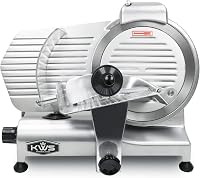
KWS is the stronger fit for repeated or larger batches: it has a 320W motor, a large tray, a removable carriage, and a built-in sharpener. Skip it if a 14 mm maximum won’t cover your target, or if you want a lightweight slicer that’s easy to put away; it weighs 37 pounds.
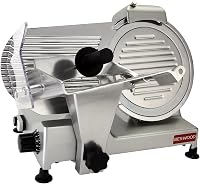
BESWOOD may suit someone who wants a 10-inch slicer with a corrosion-protected chromium-plated steel blade. Its maximum thickness is unknown, so it’s a poor choice when a particular thick cut is essential unless you confirm the range first.
For a broader look at models and uses, see our guide to meat slicers for home use. If bacon is your main reason for buying, how to choose a meat slicer size for bacon covers fit and cut considerations.
What does the thickness dial control?
The thickness dial sets the gap between the blade and the slice guide. That gap is the slicer’s nominal cut setting, but it doesn’t guarantee that every food will emerge at precisely that thickness.
A food’s firmness, shape, and position affect how it moves across the blade. Keep it steady with the food pusher, and don’t guide food by hand near the blade.
The maximum is useful only if your food fits the carriage and can be held securely. Trim an oversized or uneven piece so it sits steadily, and don’t force it through when it catches or shifts.
Does blade size determine slice thickness?
No, blade diameter alone doesn’t specify maximum slice thickness. A 10-inch blade can have a different adjustment range from another 10-inch blade.
Check the adjustment range first, then check blade diameter, carriage space, and the food pusher. These answer separate questions: how thick the slicer can cut, whether the food fits, and how you can hold it safely.
Our guide to electric food slicers for home use compares models for different kitchens. If you plan to slice frozen meat, read whether a meat slicer can cut frozen meat and follow the instructions for the model you choose.
How to compare meat slicer thickness ranges
For a thickness target under 14 mm, each model with a stated range here can cover it. Between 14 mm and 15 mm, VEVOR and CUSIMAX are the stated options; above 15 mm and up to 20 mm, only CUSIMAX reaches that range.
A target of 25.4 mm needs a different model. BESWOOD’s range is unknown, so don’t assume its 10-inch blade can make a one-inch slice.
Which settings suit common foods?
Start thin for deli-style slices and increase the setting for thicker portions. Stay within the model’s range, and adjust between cuts until the slice fits your recipe.
Thin slices work well for sandwiches and shavings. Medium settings can suit sliced roast meat or cheese, while higher settings create more substantial portions when the food and slicer can handle them.
The dial’s scale may not match a ruler exactly across models. If even thickness matters, make one initial cut, check it, and adjust before slicing the rest.
For ultra-thin cuts, KWS recommends partially freezing meat to –4°C. CUSIMAX’s instructions say not to slice frozen food, so follow the guidance for your model rather than treating all slicers alike.
How should you set up a slicer for a thick cut?
Set the slicer on a stable, level surface and check that the carriage can move freely. Secure the food with the pusher, set the dial before switching on, and keep your hands clear of the blade.
Trim food to fit the carriage and sit securely. KWS’s tray accommodates items up to 7 inches long, 7.5 inches wide, and 5.5 inches high; the other models’ carriage limits aren’t specified here, so check their manuals if you’re slicing a large piece.
Begin with a conservative setting, make a cut, and increase the thickness if needed. A high dial setting doesn’t help if the food rocks, slips, or won’t pass through the carriage safely.
What care and use mistakes should you avoid?
Unplug the slicer before cleaning or removing parts. Follow its care instructions, use the removable parts as directed, and clean food-contact surfaces after slicing so residue doesn’t carry over to the next food.
CUSIMAX lists removable blades, carriage, and food pusher, and says not to run its slicer continuously for more than 7 minutes. KWS has a removable carriage, hand guard, blade, and blade cover; BESWOOD’s product care instructions say hand wash only.
Don’t use a model beyond its stated operating guidance. Avoid pushing food with your fingers, slicing food that doesn’t fit securely, or forcing a cut when the blade slows or the food catches.
A common buying mistake is to choose by blade diameter or motor power alone. Neither replaces a stated thickness range, and neither tells you whether your food will fit the carriage.
Which slicer should you choose for your target thickness?
Choose CUSIMAX for the widest stated range, up to 20 mm, if that covers your cuts and you’re comfortable with its operating limits. Choose VEVOR if 15 mm is enough and the two blade styles suit the foods you slice.
KWS fits buyers who prioritize repeat batches, a 320W motor, and a large tray, with a maximum of 14 mm. BESWOOD is an option if its 10-inch blade and chromium-plated steel blade suit your needs, but confirm the thickness range before relying on it for thick cuts.
If your target is one inch, choose a slicer with a clearly stated maximum of at least 25.4 mm. For a target below that, match the setting to your usual cut, then check carriage fit and the model’s food and cleaning instructions before buying.
Frequently asked questions
How thick can a home meat slicer cut?
A home meat slicer’s maximum depends on its adjustment range. CUSIMAX reaches 20 mm, VEVOR reaches 15 mm, and KWS reaches 14 mm; BESWOOD’s range isn’t specified.
Check the maximum before buying, then confirm that your food fits the carriage and can be held securely.
Can a meat slicer cut 1 inch thick?
One inch is 25.4 mm, more than the stated maximums of the models covered here. Look for a slicer with a stated maximum of at least 25.4 mm, and check that the food fits the carriage and can be held with the food pusher.
Does a 10-inch blade cut thicker slices?
Blade diameter doesn’t tell you the maximum slice thickness. Check the thickness adjustment range for that model, then consider the blade and carriage dimensions to see whether your food will fit and sit securely during slicing.
Can a slicer cut frozen meat at its maximum setting?
Follow the instructions for your specific slicer. CUSIMAX says not to slice frozen food, while KWS recommends partially freezing meat for ultra-thin cuts.
Don’t force food through a slicer that is struggling, and use the food pusher to keep your hands away from the blade.