9 Best Meat Slicer for Beef Jerky (November 2026)
The best meat slicers for beef jerky include the Paladin Equipment 2-in-1 Manual Meat Tenderizer for bulk jerky batches, the Hi Mountain Beef Jerky Slicer Kit for small guided batches, and the VEVOR 8.6-Inch Deli Slicer for large roasts and long strips.
On this page (4 sections)
The best meat slicer for beef jerky for most home cooks is the Paladin Equipment 2-in-1 Manual Meat Tenderizer, which cuts a single piece of meat into up to 15 jerky strips at once and swaps to a tenderizing blade set. Pick an electric deli slicer when you need paper-thin, uniform slices from a single roast.
Jerky needs even strips more than it needs speed. Uneven slices dry at different rates, so the thinnest piece can harden while the thickest is still soft in the middle.
The best meat slicer for beef jerky gives you control over thickness and keeps each strip close to its neighbors.
Our picks split into three groups: manual jerky slicers that press and cut whole pieces, electric deli slicers for thin slices from roasts, and hand-cutting kits for cooks who like a knife. Choose by batch size and how much cleanup you can live with.
Our picks at a glance
-
1
 Best for bulk jerky batches
Paladin Equipment 2-in-1 Manual Meat Tenderizer
8.7/10 our score
See it on Amazon -
2

-
3

- 4
 Check it
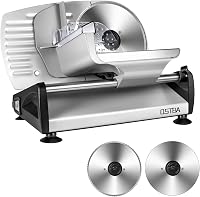
OSTBA Two-Blade 7.5-Inch Slicer
Best for easy cleaning - 5
 Check it
Borlebbi Two-Blade 7.5-Inch Slicer
Best for a tidy slicing station - 6
 Check it
Borlebbi 200W Home Meat Slicer
Best for quiet kitchen use - 7
 Check it
shop-ezy Meat slicer Stainless Steel Jerky Maker
Best for hand slicing with a board - 8
 Check it
SupMaKin Fresh Meat Slicer with SteadyGrip
Best for fresh meat into thin strips - 9
 Best for small kitchensCheck it
The best meat slicer for beef jerky, ranked by task
A manual 2-in-1 machine earns the top score for jerky because it does the whole job. It slices even strips and tenderizes them in the same setup.
The electric slicers here score next because they cut thin, uniform slices quickly and handle big roasts. The hand kits close the list for small batches and knife-savvy cooks.
Paladin Equipment 2-in-1 Manual Meat Tenderizer: Best for bulk jerky batches
- 2 sets of stainless steel blades
- 31 jerky-slicing blades
- Up to 15 strips per pass at about 3/16 inch
- C-clamps for a secure mount
Two blade sets handle both slicing and tenderizing. The wide feed port takes large cuts without much pre-cutting.
Pros
- Cuts up to 15 jerky strips at once
- Comes with a tenderizing blade set
- Easy to take apart for cleaning
Cons
- Hand crank needs steady effort
- Blades must be handled with care
This machine earns the top spot for jerky because two blade sets cover both steps of prep. The 31 jerky blades slice meat into strips about 3/16 inch thick, while 16 pairs of tenderizing blades pierce the surface so marinade reaches deeper.
In practice that means you can run a whole muscle cut through one blade set to open it up, swap the blades, and cut the strips without reaching for a second tool.
The 5.8-inch by 2-inch feed port takes large cuts without much trimming first. Paladin says one piece of meat can come out as up to 15 strips in a single pass, which matters when you're feeding a dehydrator full of trays.
Fewer passes also means fewer chances to cut strips at uneven angles.
Cast aluminum construction and the food-grade coating help the unit resist stains and odor buildup, and the C-clamps keep it steady on a table or counter so the crank stays stable. All parts come apart for hand washing.
The trade-off is effort: you crank it by hand, so a big batch takes some work. Partly thaw frozen meat and remove bones before it goes in.
Pick this if jerky is a regular hobby; skip it if you only make a small batch once a year.
Hi Mountain Beef Jerky Slicer Kit: Best for small guided batches
- Slices at 1/4 or 3/8 inch
- Hand-safe pressing plate
- 13.5-inch serrated slicing knife
- Dishwasher safe
A guided cutting board with a hand-safe plate and a long serrated knife. It is a low-cost way to get even strips without buying an appliance.
Pros
- Two set thicknesses for jerky
- Pressing plate keeps hands clear of the knife
- Dishwasher safe
Cons
- Not an electric slicer
- Only two thickness options
Hi Mountain suits cooks who want a guided cut without buying a machine. Its patent-pending board and pressing plate hold the meat still while a 13.5-inch serrated knife goes through.
The plate is the real feature here: it keeps fingers behind the blade while the meat stays flat, which is the part most people get wrong when slicing by hand.
The board sets slices at 1/4 inch or 3/8 inch, the two common jerky cuts. That's less flexible than a dial slicer, but the choice is clear and hard to get wrong.
A juice groove catches drippings and the ridged top grips the meat. The board nests for storage and flips over for general cutting.
The long 420 stainless steel knife has a rubberized handle for a steady grip, and board and knife both go in the dishwasher.
Compared with the Paladin, this kit costs less and stores flat, but it cuts one slice at a time and depends on your stroke. Pick it for small batches and beginners; skip it if you need strips thinner than 1/4 inch.
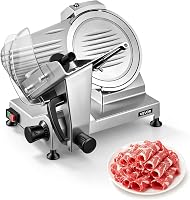
VEVOR 8.6-Inch Deli Slicer: Best for large roasts and long strips
- 8.6-inch serrated and non-serrated blades
- Thickness from 0 to 0.6 inch
- 200W motor at 70 to 100 RPM
- Dual security lock
The biggest blade here handles wide roasts and slices thin enough for a fast dry. The trade-off is a heavier cabinet to store.
Pros
- Large blade for wide cuts
- Thickness range down to a paper-thin setting
- Two blade types included
Cons
- Heaviest slicer in this group
- Hand wash only
The 8.6-inch VEVOR suits a big roast and a long drying session. Its large blade and 0 to 0.6 inch thickness dial let you set a thin jerky slice and repeat it across the whole piece.
A wide blade means fewer passes across a broad roast, so the strips come off closer to the same width as well as the same thickness.
Two SUS420 blades are included, serrated and non-serrated. The serrated blade grips fibrous beef; the smooth blade leaves cleaner edges on trimmed muscle.
A 200W motor runs at 70 to 100 RPM, and the unit has a dual security lock plus a food pusher. The reversible meat tray wipes down easily after a session.
The 14-pound cabinet takes up more counter or shelf space than the 7.5-inch models here. Everything is hand wash only.
Compared with the OSTBA, this VEVOR cuts wider pieces and gives more room on the blade. Pick it for large batches and wide roasts; choose a smaller model if storage is tight.
OSTBA Two-Blade 7.5-Inch Slicer: Best for easy cleaning
- Two 7.5-inch stainless steel blades
- Thickness up to about 3/4 inch
- 200W motor
- Removable blade, carriage and pusher
A lighter electric slicer with removable parts that make cleanup easier after a jerky session. It also covers a wide thickness range.
Pros
- Parts remove for cleaning
- Dishwasher safe
- Light enough to move easily
Cons
- Smaller blade than the VEVOR 8.6
- Semi-automatic operation only
OSTBA is the cleanup-friendly electric option. The blade, food carriage, slide bar extension and food pusher all come off, and the unit is dishwasher safe.
After a sticky jerky session that saves real time. The removable ring-guard cover also keeps debris from building up on the cutting surfaces, which is where cleanup usually gets fiddly.
It carries two 7.5-inch blades and a thickness range from super thin to about 3/4 inch. A 200W motor does the cutting and two-button start keeps the machine from running by accident.
Suction feet hold it in place.
At 8.6 pounds it's light enough to move between counters and store in a cabinet. The trade-off is blade size: a 7.5-inch blade covers less width than the 8.6-inch VEVOR, so very wide roasts need trimming first.
That top thickness of about 3/4 inch also runs past jerky territory into thicker deli cuts, so the dial has more range than jerky alone needs.
Pick it if easy cleaning matters most; skip it for the widest cuts.
Borlebbi Two-Blade 7.5-Inch Slicer: Best for a tidy slicing station
- Two removable 7.5-inch blades
- Stainless steel tray included
- Thickness from 0 to 15 mm
- Die-cast aluminum body
The included stainless steel tray catches strips as you cut. A die-cast aluminum body gives it a sturdier feel than the lighter models.
Pros
- Tray keeps slices contained
- Two blade types for meat and other foods
- Compact footprint
Cons
- Hand wash only
- Heavier than the OSTBA
This Borlebbi model is built around keeping your slicing area tidy. A stainless steel tray catches strips as they come off the blade, so you're not chasing meat across the counter.
For jerky that matters, because strips that land in a pile can stick together before they ever reach the dehydrator.
The die-cast aluminum body feels sturdier than the lighter slicers here, and the 10.7-pound weight keeps it from sliding. Two removable 7.5-inch blades and a 0 to 15 mm thickness dial cover jerky strips and deli cuts.
The food pusher doubles as a blade guard and the non-slip feet add stability.
Its compact size fits most cabinets. The controls are simple, and the removable blade, carriage and pusher make cleaning straightforward.
Against the OSTBA, it trades dishwasher-safe parts for the included tray and a heavier body. Pick it for a neat work station; skip it if you'd rather load everything in the dishwasher.
Borlebbi 200W Home Meat Slicer: Best for quiet kitchen use
- 200W DC motor
- Two 7.5-inch blades
- Thickness from 0 to 15 mm
- Child safety lock and non-slip feet
A DC motor is the draw here for buyers who slice indoors and want less noise. The two blade set and safety lock cover the basics.
Pros
- DC motor runs quieter
- Blade cover and child lock
- Stainless steel tray included
Cons
- Same 15 mm top thickness as the other 7.5-inch models
- Hand wash only
Borlebbi's 200W model is the quiet pick. Its DC motor is designed for stable torque with lower noise, which helps if you slice jerky in a kitchen next to living space.
Steady torque also means the blade keeps its speed through a dense cut instead of bogging down, so strips come out more even.
It includes two removable 7.5-inch blades, a serrated and a non-serrated, plus a stainless steel tray. The thickness dial runs from 0 to 15 mm and a child safety lock stops accidental starts.
The blade cover protects your hands and four suction feet hold the unit down on the counter.
Detachable parts make cleaning straightforward, though the unit is hand wash only. The removable food carriage comes off with a detachable button, so you can reach the blade and deflector.
Compared with the other Borlebbi, this one gives up the die-cast body for quieter running. Pick it for indoor slicing in a shared home; skip it if you want the sturdiest cabinet here.
shop-ezy Meat slicer Stainless Steel Jerky Maker: Best for hand slicing with a board
- 10-inch stainless steel knife
- Stainless steel jerky board
- Thickness at 1/8, 1/4 or 3/8 inch
- Nylon spacers set the cut
A simple kit for cooks who already have knife skills. The board sets three thicknesses and the long blade handles trimming too.
Pros
- Three thickness settings
- Long knife doubles as a trimming blade
- Compact to store
Cons
- Not for frozen meat
- Depends on the cook's knife control
The shop-ezy kit suits cooks who already know how to use a knife. Its 10-inch stainless steel blade handles trimming and slicing, and the stainless board sets cuts at 1/8, 1/4 or 3/8 inch with nylon spacers.
The pointed tip and slight flex on the blade make it useful for trimming silver skin and deboning before you ever start on strips.
That 1/8-inch setting is the thinnest cut in this group. Thin strips dry faster, which helps if you're short on dehydrator space.
The board measures 6 by 12 inches and has a slip-resistant base. It also works for fruit and vegetables you want to dry.
It's not for frozen meat, so let beef soften first. And without a guide plate, even strips depend on your own control.
The spacers set the height, but the angle and pressure are yours to manage.
Compared with the Hi Mountain kit, this one offers more thickness choices but less hand protection. Pick it for thin strips and small batches; skip it if you want the slicer to set the thickness for you.
SupMaKin Fresh Meat Slicer with SteadyGrip: Best for fresh meat into thin strips
- 17 blades cut 18 slices in one stroke
- Thickness at 2 or 4 mm
- Suction base
- Cleaning brush included
A compact manual cutter for fresh meat. The two settings suit thin strips and the container doubles as the cutting guide.
Pros
- 18 slices in one press
- Wall-mountable to save space
- Light and easy to store
Cons
- Not for frozen or deli meat
- Limited to two thicknesses
SupMaKin is a manual cutter for fresh meat. 17 blades cut 18 thin slices in one stroke, and the two blade sets set slices at 2 or 4 mm.
Put the slices back in the container and cut again for strips or dice.
The container doubles as the guide, so the meat stays square as you press.
The suction base, sold as SteadyGrip, holds it to a smooth counter. It weighs 16 ounces and can mount on a wall to free counter space.
A cleaning brush comes in the box. The blades have an 8-degree edge for a clean cut through fresh muscle.
It's not for frozen or deli meat, so use it on fresh beef, pork, chicken breast or salmon. The 2 and 4 mm settings suit very thin jerky, but you can't dial in a 3/16-inch cut.
That 2 mm setting dries fast, so watch the trays closely.
Pick it for thin strips from fresh meat and small kitchens; skip it for thick, chewy jerky or frozen cuts.
VEVOR 7.5-Inch Deli Slicer: Best for small kitchens
- 7.5-inch serrated and non-serrated blades
- Thickness from 0 to 0.6 inch
- 200W motor
- 1 mm recessed blade
The lightest electric slicer here, with a recessed blade and two blade types. It fits on a small counter and stores without much fuss.
Pros
- Lightest electric model here
- Recessed blade for safety
- Two blade types included
Cons
- Smaller blade than the VEVOR 8.6
- Hand wash only
The 7.5-inch VEVOR is the lightest electric slicer here at 8.4 pounds. It suits small kitchens and buyers who want to move the machine in and out of a cabinet.
It has two 7.5-inch SUS420 blades, a 200W motor and a 0 to 0.6 inch thickness dial. A 1 mm recessed blade adds a little safety margin and the food pusher keeps fingers back.
The motor runs at 70 to 100 RPM, the same range as the larger VEVOR.
The reversible meat tray design and removable parts make wiping down easy. Suction feet hold it steady, and the semi-automatic carriage helps feed meat through.
The blade, pusher and slide bar extender all come off for cleaning.
Against the 8.6-inch VEVOR, this one is lighter and easier to store but cuts less width per pass. Pick it for small counters; choose the larger VEVOR for big roasts.
How these meat slicers were compared
We ranked these slicers on what jerky making actually needs: a repeatable thickness, enough blade width for your cuts, a blade type that grips beef, and cleanup that doesn't eat your evening. Scores weigh specs and features against those needs.
A manual 2-in-1 ranks high because it slices and tenderizes in one pass. Electric models earn their place on speed and consistency.
Hand kits score lower for jerky because they depend on the cook's knife control. We also looked at storage size and safety features, since most home kitchens are short on both counter space and patience for a risky blade.
The thickness ranges mattered too, because a dial that stops at 1/4 inch or starts at 2 mm tells you a lot about which jerky style the machine was built for. Weight, blade count and whether the parts come off all fed into the score as well.
| Product | Best for | Feed port | Strips per pass | Operation | Our score |
|---|---|---|---|---|---|
| Paladin Equipment 2-in-1 Manual Meat Tenderizer | bulk jerky batches | 5.8 x 2 in | Up to 15 | Manual | 8.7 |
| Hi Mountain Beef Jerky Slicer Kit | small guided batches | 8.5 | |||
| VEVOR 8.6-Inch Deli Slicer | large roasts and long strips | 8.3 | |||
| OSTBA Two-Blade 7.5-Inch Slicer | easy cleaning | 8.2 | |||
| Borlebbi Two-Blade 7.5-Inch Slicer | a tidy slicing station | 8.1 | |||
| Borlebbi 200W Home Meat Slicer | quiet kitchen use | 8.0 | |||
| shop-ezy Meat slicer Stainless Steel Jerky Maker | hand slicing with a board | 7.9 | |||
| SupMaKin Fresh Meat Slicer with SteadyGrip | fresh meat into thin strips | 7.8 | |||
| VEVOR 7.5-Inch Deli Slicer | small kitchens | 7.7 |
What to check before you buy a jerky slicer
The right slicer depends on how much meat you cut and how thick you like your strips. Check these four points before you decide.
What thickness do you need for jerky?
Most jerky recipes call for 1/8 to 1/4 inch. Thin strips dry faster and give a crisp snap; thicker slices take longer and come out chewier.
A slicer with a dial or set guides keeps the thickness the same across the whole batch. That matters more than top speed, because a single thick strip can spoil a tray.
If you like thin jerky, look for a model that goes below 1/4 inch. The shop-ezy board reaches 1/8 inch; the SupMaKin cuts at 2 mm.
If you like a chewier bite, the 3/8-inch settings on the Hi Mountain and shop-ezy boards are the ones to use. The Paladin's fixed 3/16 inch sits between the two.
Is manual or electric better for your batch size?
Manual slicers suit small batches and kitchens where noise matters. They're also easier to store.
Electric slicers win on speed and consistency for large roasts. A 200W model like the OSTBA or VEVOR will run through a big piece in less time than a hand crank.
Think about how often you make jerky: weekly batches point to electric, a few times a year points to manual. The Paladin sits in the middle: manual effort, but a high strip count per pass.
If your hands tire easily or you process a whole deer each season, the motor does the heavy work for you.
How much counter space and storage do you have?
Electric slicers range from about 8 to 14 pounds here. The lighter 7.5-inch models fit a cabinet more easily; the 8.6-inch VEVOR takes more room.
Manual machines like the Paladin clamp to a table and can be taken apart for storage. Hand kits store flat.
Measure your cabinet before buying an electric model. If your counter is short, the wall-mountable SupMaKin or a flat kit makes more sense.
Also check the height with the carriage attached, since a slicer that clears your cabinet door when stored may still be awkward to lift onto a high shelf.
Which blade type grips beef best?
A serrated blade handles the fibrous texture of beef and holds the meat as it cuts. A non-serrated blade gives cleaner edges on trimmed muscle.
Many electric models here include both, so you can switch by cut. Manual machines like the Paladin use fixed blade sets built for strips.
Hand kits depend on the knife: the Hi Mountain kit uses a serrated knife, while the shop-ezy uses a long straight blade. Serrated is the safer default for jerky.
If your beef is well trimmed and partly chilled, a smooth blade can leave tidier edges on the finished strips.
Should you chill or partly freeze beef before slicing?
Chilling beef for 30 to 60 minutes firms the muscle so a knife or blade bites cleanly instead of tearing. A slicer with a feed port handles that firm meat well as long as it isn't frozen solid.
The Paladin asks for partly thawed meat rather than rock-hard cuts, and the hand kits aren't meant for frozen meat at all. Firm, cold beef gives you straighter strips and less ragged edge, which dries more evenly.
Let fully frozen meat soften before it goes near any blade here.
Which jerky slicer suits your kitchen?
The Paladin 2-in-1 is the clear pick for anyone who makes jerky in batches. It slices and tenderizes in one setup, cuts up to 15 strips per pass, and clamps down so the cut stays steady.
For everything else, match the tool to the job.
Pick an electric deli slicer like the VEVOR 8.6-inch or OSTBA when you want thin, repeatable slices from a single roast with less hand effort. Pick a hand kit like the Hi Mountain board when you make small batches and want a guided cut with your own knife.
Pick the SupMaKin for very thin strips from fresh meat in a small kitchen. The two VEVOR sizes and the two Borlebbi models let you trade blade width against weight and storage.
If price is the deciding factor, our roundup of the best meat slicers for the money covers budget options. For a full look at one popular model, read the CUSIMAX meat slicer review.
And before you chill or freeze beef for slicing, check whether a meat slicer can cut frozen meat.
Slicing for sandwich meat or pit beef instead? Our best meat slicers for pit beef guide covers the wider blades and carving setups those cuts need.
Our top 3 picks at a glance
-
1
Best for bulk jerky batches
Paladin Equipment 2-in-1 Manual Meat Tenderizer
8.7/10 our score
See it on Amazon -
2
-
3
Frequently asked questions
What thickness should beef jerky be sliced?
Most jerky recipes call for slices between 1/8 and 1/4 inch thick. Thinner strips dry faster, while 1/4-inch slices give a chewier bite and need more drying time.
Do I need a tenderizer as well as a slicer?
Only if you start with whole muscle cuts that can be tough. A tenderizing blade set pierces the meat so marinade reaches deeper.
A slicer alone still works for jerky, especially with round steak or flank.
Can I slice partially frozen beef for jerky?
Yes. Slightly firm meat is easier to cut into even strips, and many cooks chill beef for 30 to 60 minutes before slicing.
Fully frozen meat needs different equipment, so let it soften first.
Is a manual or electric slicer better for jerky?
Manual slicers suit small batches and cooks who want less noise and cleanup. Electric slicers are faster and more consistent for large roasts.
The right one depends on how often you make jerky and how much meat you cut each time.
How do I keep jerky strips the same thickness?
Use a slicer with a set thickness or a cutting board with spacer guides. Even strips dry at the same rate, which matters for safe, consistent jerky.
A scale or a quick check during drying helps too.
What blade works best for jerky strips?
A serrated blade handles the fibrous texture of beef well and grips the meat as it cuts. A non-serrated blade gives cleaner slices on trimmed, uniform muscle.
Most electric slicers here include both types.